Author: Karen Converse

  • The -Brrr Months Are Here: Why Embroidered Jackets Make Great Team Gear

    The -Brrr Months Are Here: Why Embroidered Jackets Make Great Team Gear

    The “-ber” months are here, and that usually means cooler mornings, layered clothing, and the return of jackets around the office, jobsite, and everywhere in between.

    It is also a great time to think about branded outerwear.

    Custom embroidered jackets are one of the most useful pieces of company apparel because they combine function with a polished, professional look. They also make great employee gifts, team apparel, and year-end recognition pieces.

    Why Embroidery Works So Well on Outerwear

    Embroidery gives jackets a clean, professional finish that holds up well over time.

    It works especially well for company logos, employee names, departments, and team branding. Compared with a larger printed graphic, embroidery can give outerwear a more refined look that works just as well in an office as it does at an event or on a jobsite. And because jackets tend to be worn for several seasons, your logo gets a lot of visibility. Here are some embroidery tips.

    There Is a Jacket for Every Kind of Team

    “Company jacket” can mean a lot of different things depending on how and where your employees work.

    Soft Shell Jackets

    Soft shells are a great option for office staff, sales teams, managers, and employees who move between indoor and outdoor environments. They are lightweight, polished, and easy to layer.

    Fleece

    Fleece jackets and quarter-zips are comfortable, versatile, and easy to wear. They work well for offices, schools, healthcare teams, and organizations looking for something warm without being too heavy.

    Insulated and Puffer Jackets

    For employees who spend more time outdoors, insulated jackets and puffers provide more warmth while still offering a professional branded look.

    Work Jackets

    For field crews, construction teams, service companies, and other hands-on jobs, durable work jackets can provide both warmth and a consistent company appearance.

    Vests

    Sometimes you want warmth without a full jacket. Embroidered vests are a good option for layering and can work especially well for sales teams, event staff, and employees who are frequently on the move.

    A Company Gift People Will Actually Use

    The end of the year is also approaching, which means many businesses are starting to think about employee appreciation and holiday gifts.

    A quality jacket can be a great alternative to another mug, pen, or desk item.

    It is useful, it feels substantial, and employees can wear it both at work and outside of work.

    Adding an embroidered company logo creates a gift that also helps strengthen team identity without feeling overly promotional.

    You can also personalize jackets with employee names, departments, or other details to make the gift feel more individual.

    Choosing the Right Outerwear

    Before selecting a jacket, think about how your team will actually use it.

    Ask yourself:

    • Will employees mostly wear it indoors or outdoors?
    • Do they need lightweight layering or serious warmth?
    • Does the jacket need to look professional in front of customers?
    • Will employees be working physically while wearing it?
    • Do you want something employees can wear outside of work?
    • What budget makes sense for the size of your team?

    The best jacket is not necessarily the most expensive one. It is the one that fits how your employees work and what they will actually wear.

    Come See and Feel the Options

    Outerwear is one of those products that can be difficult to choose from a picture alone.

    Fabric weight, lining, stretch, fit, and overall feel can vary significantly from one jacket to another.

    Black Duck’s Albuquerque showroom has samples of many apparel styles so you can compare options in person, see how garments fit, and feel the fabrics before making a decision.

    If there is a specific jacket, style, color, or size you would like to evaluate that we do not currently have in the showroom, we can often bring in a sample for you. Sample costs vary depending on the item and the number of samples requested.

    Planning Jackets as a Holiday or Year-End Gift?

    Start early.

    Jackets involve more decisions than a basic T-shirt order, especially when you are coordinating sizes for an entire team.

    You will want time to:

    1. Select the jacket
    2. Review samples if needed
    3. Collect employee sizes
    4. Finalize embroidery artwork
    5. Approve the order
    6. Complete production before your event or gift date

    Our standard production lead time is approximately 10 working days after artwork approval and order details are finalized, but product availability and larger orders can affect timing.

    October is a great time to start if you are considering jackets for the holidays, employee appreciation, winter uniforms, or year-end gifts.

    Make the -Brrr Months a Little Warmer

    Whether you need lightweight office jackets, fleece for the whole team, durable workwear, or personalized holiday gifts, custom embroidered outerwear is a practical way to keep your team warm and your brand visible.

    Black Duck can help you choose the right jacket, prepare your embroidery, and make sure your team looks good heading into the colder months.

    Ready to layer up your team? Stop by our showroom or contact us to start exploring embroidered outerwear options.

  • Merch With a Mission: A Year-Round Guide to Awareness Campaigns

    Merch With a Mission: A Year-Round Guide to Awareness Campaigns

    September is a great time to start thinking about fall awareness campaigns.

    October brings increased attention to Breast Cancer Awareness Month, but throughout the year, businesses, schools, nonprofits, healthcare organizations, sports teams, and community groups support causes that matter to their employees, customers, and communities.

    Merchandise can help turn that support into something visible.

    A thoughtfully designed T-shirt, hoodie, hat, pin, tote bag, water bottle, or other promotional item can bring people together, start conversations, support fundraising, recognize participants, and help extend awareness beyond a single event.

    There’s a Cause for Every Month

    Awareness campaigns happen all year long. Here are some of the more recognizable observances organizations may want to plan around:

    MonthAwareness & Cause Ideas
    JanuaryBlood Donor Month, Cervical Cancer Awareness
    FebruaryAmerican Heart Month, Black History Month, Cancer Prevention
    MarchWomen’s History Month, Colorectal Cancer Awareness, Developmental Disabilities Awareness, Multiple Sclerosis Awareness
    AprilAutism Acceptance, Child Abuse Prevention, Sexual Assault Awareness, Earth Month
    MayMental Health Awareness, Military Appreciation, Skin Cancer Awareness, Stroke Awareness
    JunePride Month, Alzheimer’s & Brain Awareness, Cancer Survivors Month, PTSD Awareness, Men’s Health Month
    JulyDisability Pride Month, Minority Mental Health Awareness
    AugustNational Immunization Awareness, Back-to-School and Community Support Campaigns
    SeptemberChildhood Cancer Awareness, Suicide Prevention, Recovery Month, Ovarian Cancer Awareness, Prostate Cancer Awareness
    OctoberBreast Cancer Awareness, Domestic Violence Awareness, Down Syndrome Awareness, ADHD Awareness
    NovemberDiabetes Awareness, Lung Cancer Awareness, Alzheimer’s Awareness, Veterans and Military Family Month, Men’s Health
    DecemberHIV/AIDS Awareness, Human Rights Month, Holiday Giving and Community Service Campaigns

    This is only a starting point. There are hundreds of local, national, and industry-specific causes throughout the year, so organizations can choose the ones that have the strongest connection to their employees and communities.

    Awareness Merchandise Does More Than Promote a Logo

    The most effective cause-related merchandise is about more than branding.

    It can help:

    • Bring employees, volunteers, or participants together around a shared effort
    • Start conversations about an important issue
    • Recognize survivors, caregivers, volunteers, or supporters
    • Raise money through merchandise sales
    • Give participants something meaningful to wear at a walk, fundraiser, tournament, or community event
    • Keep the message visible long after the event is over

    When someone continues wearing a shirt or carrying a tote months later, the message continues with them.

    Think Beyond the Traditional Awareness Shirt

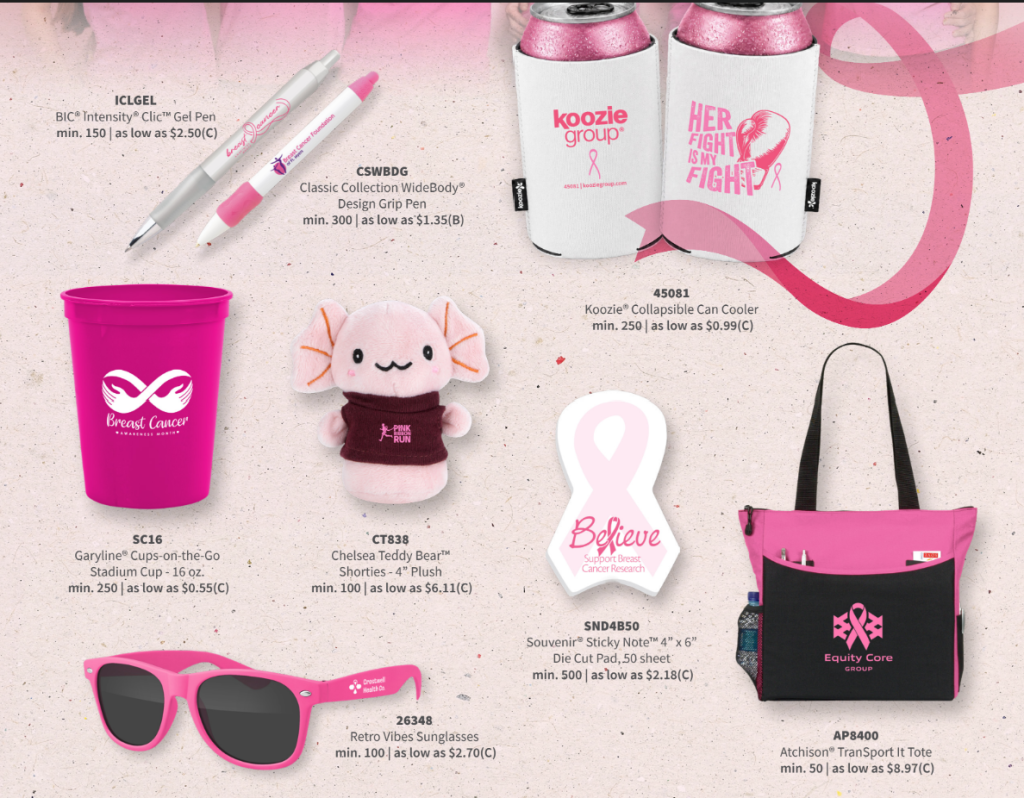
    September Blog Pink Merch

    Cause-related merchandise does not have to be a basic T-shirt with a ribbon and logo.

    Organizations can create apparel people genuinely want to wear, including soft tees, hoodies, polos, hats, performance shirts, and jackets.

    Promotional products can also play an important role. Pins, stickers, wristbands, water bottles, tote bags, notebooks, and other useful items can reinforce the message or become part of an event giveaway or fundraising package.

    The best campaigns combine the cause with the personality of the organization instead of simply adding a logo to a generic design.

    Make It Personal

    Awareness campaigns often have the greatest impact when there is a genuine connection behind them.

    Maybe an employee is a cancer survivor. A team member is participating in a charity walk. A local nonprofit needs sponsors. Employees want to support mental health awareness, veterans, heart health, childhood cancer, or another cause close to their families.

    Those stories can become the foundation of the campaign.

    Consider letting employees submit ideas, vote on a shirt design, or nominate organizations your company could support. Participation often grows when people feel connected to the effort.

    Merchandise Can Help Raise Funds, Too

    Awareness apparel and promotional products can also become fundraising tools.

    A company might sell shirts and donate a portion of the proceeds, sponsor apparel for a nonprofit event, create an employee fundraising campaign, or provide merchandise that a charitable organization can sell directly.

    If fundraising is part of the plan, decide early how proceeds will be handled and clearly communicate how the purchase supports the organization or cause.

    Plan Earlier Than You Think

    If you want shirts ready for an October event, September is the time to start.

    A successful campaign may include:

    1. Choosing the cause or organization
    2. Deciding what type of campaign you want to run
    3. Selecting apparel or promotional products
    4. Creating and approving artwork
    5. Collecting sizes or orders
    6. Producing the merchandise
    7. Distributing everything before the event

    Starting early also gives you more flexibility with garment styles, colors, sizing, specialty products, and quantities.

    And the same principle applies all year long. If Mental Health Awareness Month is important to your organization, start planning before May. If you participate in a September childhood cancer fundraiser every year, start talking about merchandise during the summer.

    Turn Your Awareness Calendar Into a Plan

    Take a look at the year ahead and identify one or two causes that genuinely matter to your organization.

    Then think about what you want your campaign to accomplish.

    Is the goal awareness? Employee participation? Fundraising? Community involvement? Supporting a local nonprofit?

    Once you know the goal, merchandise becomes one of the tools that can help bring the campaign together.

    At Black Duck, we can help with screen printing, embroidery, promotional products, custom merchandise, fundraising apparel, and company stores for awareness campaigns of just about any size.

    Have a cause you want to support? Let’s create something people will be proud to wear.

  • The Vintage Feel of Screen Printing Never Goes Out of Style

    The Vintage Feel of Screen Printing Never Goes Out of Style

    Some of the most-loved shirts in your closet probably have something in common.

    They’ve been washed dozens, maybe hundreds, of times. They’re soft. The print has aged gracefully. Maybe it has a little character to it. And somehow, they only seem to get better with time.

    Chances are, they’re screen printed.

    With the rise of heat transfers and DTF printing, it’s easier than ever to put almost any image on a shirt. Those technologies have opened up some incredible possibilities, especially for short runs, personalization, names and numbers, and highly detailed graphics.

    But when it comes to creating shirts people reach for year after year, screen printing still has something special.

    Why Screen Printing Feels Different

    A great screen print becomes part of the shirt.

    Instead of sitting heavily on top of the fabric, properly printed ink works with the garment to create a softer feel that only improves with age. Over time, the print develops the worn-in character people love in vintage band shirts, brewery shirts, and favorite college tees.

    That slightly faded look isn’t a flaw. It’s part of the charm.

    Some brands spend thousands trying to recreate that vintage feel. Traditional screen printing creates it naturally.

    Bigger Graphics Aren’t Always Better

    One of the biggest trends today is large, full-color graphics created with heat transfers.

    They can look fantastic, and they absolutely have their place. For smaller quantities and customization, they’re often the perfect solution.

    But large transfer prints can sometimes feel heavier on the shirt, especially when they cover a significant portion of the fabric. If comfort is the priority, sometimes less really is more.

    A thoughtfully designed screen print with a few colors often feels lighter, breathes better, and delivers a more premium experience.

    Simple Designs Age Beautifully

    Some of the best shirts ever made weren’t complicated.

    Think about:

    • Vintage concert shirts
    • Brewery and distillery merchandise
    • Classic college apparel
    • Old surf brands
    • Favorite local business shirts

    Most relied on simple artwork, strong typography, and limited colors. Those designs printed beautifully when new and still look great years later.

    Choosing the Right Print Method

    Every project is different, and there isn’t one perfect answer.

    Screen Printing Excels At:

    • Medium and large quantities
    • Soft-hand prints
    • Vintage-inspired looks
    • Brand merchandise
    • Staff apparel
    • Shirts designed for long-term wear

    Heat Transfers and DTF Shine For:

    • Small runs
    • Names and numbers
    • Full-color graphics
    • Frequent design changes
    • One-off customization

    Neither method is “better.” They simply solve different problems.

    The Shirt Matters Too

    The magic happens when great printing meets the right garment.

    Ring-spun cotton and tri-blends pair exceptionally well with screen printing, creating that soft, broken-in feel people associate with their favorite old shirts.

    When the right garment and the right print method come together, the result is something customers actually want to wear instead of something that ends up in the back of a drawer.

    Still the Gold Standard

    Technology continues to evolve, and we use multiple decoration methods at Black Duck because each has its strengths.

    But there’s a reason screen printing has remained the gold standard for decades.

    A great screen-printed shirt doesn’t just look good on day one.

    It becomes someone’s favorite shirt.  

    Need help creating the perfect shirt? Whether you’re after that soft, vintage screen-printed feel or need another decoration method for your project, we’re here to guide you through every step. Our goal is simple: to help you create shirts people won’t just wear once, but shirts they’ll reach for again and again. Click here to get started!

  • Optimizing Your Screen Print Design: How to Get the Best Looking Shirts

    Optimizing Your Screen Print Design: How to Get the Best Looking Shirts

    A great screen print starts long before the ink hits the shirt.

    The difference between an average shirt and one people genuinely want to wear often comes down to the design itself in how it’s built, how it’s colored, and how well it works with the screen printing process.

    At Black Duck, we see it all the time: small design decisions can make a huge impact on the final product.

    Whether you’re creating shirts for your business, event, staff, brewery, school, or brand, here are some of the biggest ways to optimize your screen print design for the best possible results.

    Simpler Designs Often Print Better

    One of the biggest misconceptions is that more detail automatically means a better shirt. In reality, clean and intentional designs almost always produce stronger prints. Screen printing shines when designs have:

    • Clear shapes
    • Strong contrast
    • Readable typography
    • Balanced spacing
    • Intentional use of color

    Overly detailed artwork can become muddy on fabric, especially on smaller print areas.

    A bold, clean design usually:

    • Prints sharper
    • Holds up better over time
    • Feels softer
    • Looks more professional

    Color Count Matters

    Every ink color in traditional screen printing requires its own screen and setup. That means color count directly affects production complexity and cost. For many projects, the sweet spot is:

    • 1–3 colors for clean, bold branding
    • 3–5 colors for more detailed artwork
    • Higher color counts for specialty or retail-style prints

    Some of the best-looking shirts are surprisingly simple.

    A strong two-color print on the right shirt can often look more premium than a complicated design with eight colors.

    Bigger Runs Create Better Value

    Our minimum for screen printing is 12 pieces, but screen printing becomes significantly more cost-effective as quantities increase. That’s because setup costs are spread across more shirts.

    Generally:

    • Small runs work great for staff shirts or limited events
    • Mid-sized runs offer the best balance of price and flexibility
    • Larger runs dramatically reduce per-shirt cost

    If you’re building a brand, event, or merch line, ordering a larger run upfront can often provide far more value long-term.

    Choose the Right Shirt for the Design

    Not all garments print the same way. The fabric, texture, and material blend all affect how ink lays down and how the final print feels.

    For example:

    • Ring spun cotton creates a softer, smoother print surface
    • Heavier shirts give prints more structure
    • Performance fabrics may require specialty inks
    • Tri-blends produce a softer, more vintage appearance

    The best print isn’t just about the artwork — it’s about pairing the artwork with the right garment. We have a blog post about the types of shirts here.

    Vector Artwork Makes a Huge Difference

    One of the most common production issues comes from low-resolution artwork. For the cleanest print possible, vector art is always preferred because it can scale without losing quality. Good artwork files include:

    • AI
    • EPS
    • SVG
    • High-resolution PDF

    Low-resolution screenshots or website images often need to be rebuilt before production.

    Placement Matters More Than You Think

    A great design can still feel awkward if placement is off. Standard full front prints are common for a reason because they work. But depending on the brand and audience, other placements can create a more elevated look:

    • Left chest prints
    • Oversized back prints
    • Sleeve prints
    • Pocket-area prints
    • Hem or tag details 

    Sometimes a smaller, cleaner placement actually creates a more retail-inspired feel.

    Final Thoughts

    The best screen printed shirts aren’t always the loudest or most complicated. They’re the ones that balance:

    • Great artwork
    • Smart color choices
    • Proper garment selection
    • Thoughtful placement
    • Quality production

    At Black Duck, we help clients optimize designs every day to ensure the final product looks sharp, feels great, and holds up over time.

    If you’re planning a shirt project and want guidance on artwork, garment selection, or print methods, we’re always happy to help. Call us or email for more information.

  • Premium Corporate Gifting Is Changing — And So Are We

    Premium Corporate Gifting Is Changing — And So Are We

    W/GOOD CO.

    For years, branded merchandise was often treated as an afterthought: basic promo items, inexpensive giveaways, and products designed simply to get a logo into someone’s hands.

    But corporate gifting has evolved.

    Today’s companies want merchandise that people actually use, keep, wear, and talk about. They want onboarding kits that feel intentional. Executive gifts that feel premium. Event merchandise that reflects their brand identity — not just their logo.

    At Black Duck, we’ve been watching that shift happen across nearly every industry we serve.

    That’s why we’re excited to announce our partnership with W/GOOD CO. (www.wgood.co), giving us access to a wide range of premium retail brands for custom corporate gifting, apparel, bags, drinkware, and lifestyle merchandise.

    Moving Beyond Traditional Promo Products

    This partnership allows Black Duck to source elevated retail products with wholesale pricing and corporate purchasing terms — helping our clients create branded merchandise programs that feel more modern, polished, and intentional.

    Instead of standard giveaway products, companies are increasingly looking for:

    • Premium backpacks and travel gear
    • Executive apparel
    • Curated onboarding kits
    • Lifestyle products employees actually want
    • Higher-end client appreciation gifts
    • Event merchandise with retail-quality appeal

    And honestly, we get it.

    The right product says something about your company. It reflects your culture, your standards, and how much thought you put into the experience.

    Why Premium Branding Matters

    A branded item should do more than display a logo. The best corporate merchandise creates connection:

    • Employees feel valued
    • Clients feel appreciated
    • Event attendees remember the experience
    • Brands feel more cohesive and elevated

    We recently saw this firsthand when Teamshares approached us looking for personalized bags from RAINS — a sleek, modern retail brand known for minimalist design and premium quality.That project perfectly represented where branded merchandise is heading:
    thoughtful products, intentional branding, and a focus on quality over quantity.

    What This Means for Our Clients

    This expanded sourcing capability allows Black Duck to help clients create merchandise programs that go well beyond t-shirts and pens.

    We can now help companies build:

    • Executive gifting programs
    • Employee welcome kits
    • Conference and retreat merchandise
    • Premium branded apparel collections
    • Corporate holiday gifts
    • Client appreciation packages
    • Curated merchandise bundles

    And because we still handle customization, decoration, fulfillment, and production support, clients get the convenience of working with one trusted partner throughout the process.

    A New Level of Branding Support

    At Black Duck, we’ve always believed branded merchandise should feel like an extension of the company behind it.

    This partnership simply gives us more tools to help our clients create merchandise experiences that feel elevated, memorable, and aligned with their brand identity.

    Whether you’re looking for premium apparel, modern travel gear, executive gifts, or curated branded merchandise, we’re excited to help bring those ideas to life.

    If you’re interested in exploring premium branded products for your company, we’d love to start the conversation. Call us or email for more information.

  • Why Screen Printing Is Still the Gold Standard for Custom Apparel

    Why Screen Printing Is Still the Gold Standard for Custom Apparel

    When it comes to decorating apparel, there are more options than ever—heat transfers, vinyl, digital prints, and more.

    But even with all the new technology, screen printing continues to be the go-to method for businesses, events, and brands that want quality that lasts.

    At Black Duck, we work with all types of decoration methods. And while each has its place, screen printing consistently delivers the best combination of comfort, durability, and value—especially for most bulk orders. Here’s why.

    1. It Feels Better to Wear

    One of the biggest differences you’ll notice right away is how the print feels.

    With screen printing, the ink is pressed into the fabric rather than sitting heavily on top of it. The result is a softer, more breathable print that moves with the shirt.

    If you’ve ever worn a shirt with a thick, rubbery design that feels stiff or heavy, you’ve experienced the alternative.

    Bottom line: Screen printing feels more like part of the shirt, not something stuck onto it.

    2. It Holds Up Over Time

    Durability matters—especially if you want people to keep wearing your shirt.

    Screen-printed designs are known for their longevity. When done correctly, they won’t crack, peel, or degrade the way heavier applications can over time.

    That means your brand stays looking sharp wash after wash.

    Bottom line: If you want a shirt that lasts, screen printing is hard to beat.

    3. It’s More Comfortable in the Heat

    Here in Albuquerque, lightweight and breathable apparel isn’t optional—it’s essential.

    Because screen printing doesn’t create a thick layer on top of the fabric, it allows the shirt to breathe naturally.

    That makes a big difference for:

    • Outdoor events
    • Summer staff uniforms
    • Active or on-the-go teams

    Bottom line: Less bulk = more comfort, especially in warm climates.

    4. It’s the Best Value for Bulk Orders

    If you’re ordering for a team, event, or organization, screen printing offers the best value at scale.

    Once the setup is complete, the cost per shirt becomes very efficient—especially compared to other methods that can get expensive as quantities increase.

    Bottom line: The more you print, the more screen printing makes sense.

    5. It Delivers Consistent, Professional Results

    Consistency matters when you’re printing dozens—or hundreds—of shirts.

    Screen printing produces clean, vibrant designs that look the same from the first shirt to the last. That’s a big deal for brand presentation.

    Bottom line: You get a polished, reliable result every time.

    When Other Methods Make Sense

    There are situations where other decoration methods are the right choice—like very small runs, highly detailed graphics, or specialty applications.

    But for most apparel programs, especially anything with volume, screen printing continues to be the gold standard.

    Final Thought

    The best decoration method isn’t about what’s newest, it’s about what works best for your goals.

    If you want something that looks great, feels comfortable, and holds up over time, screen printing is still the way to go.

    Not sure what’s right for your project?

    We’ll help you choose the best option based on your design, budget, and timeline.

    Get your custom quote today.

    Call us or email for more information.


  • Types of T-Shirts: Which One is Right for Your Brand or Event?

    Types of T-Shirts: Which One is Right for Your Brand or Event?

    When it comes to custom apparel, not all t-shirts are created equal. Choosing the right shirt can make the difference between something people wear once and something they reach for every week.

    At Black Duck, we help customers navigate the options every day. Here’s a breakdown of the most common t-shirt types and when to use them.

    1. 100% Cotton Tees
      • Best for: Events, giveaways, budget-conscious orders. Cotton shirts are the classic choice. They’re affordable, breathable, and widely available in a variety of colors.
        • Pros:
          • Budget-friendly
          • Great for large orders
          • Easy to print on
        • Cons:
          • Can shrink
          • Not as soft as premium blends
      • Best use: Large events, fundraisers, or one-time wear.
      • Our Pick:  Gildan Ultra Cotton 100% US Cotton T-Shirt
    2. 50/50 blend
      • Best for: Everyday wear, staff shirts, balanced comfort, and durability. 50/50 blends combine cotton and polyester to give you the best of both worlds: comfort with added durability and less shrinkage.
        • Pros:
          • More durable than 100% cotton
          • Less shrinkage
          • Good value for quality
          • Holds shape and color better over time
        • Cons:
          • Not as soft as tri-blends
          • Slightly less breathable than 100% cotton
      • Best use: Company uniforms, repeat-wear shirts, budget-friendly upgrades from basic cotton.
      • Our Pick: Port & Co Core Blend Tee.
    3. Tri-Blend Tees (Cotton/Poly/Rayon)
      • Best for: Retail, branded merch, premium feel. Tri-blends are incredibly soft and have that “favorite shirt” feel right out of the box.
        • Pros:
          • Ultra-soft
          • Modern fit
          • Higher perceived value
        • Cons:
          • Higher cost than standard tees
          • Slightly more fitted/modern cut (may not suit all body types)
          • Lightweight feel may not be preferred by those who like heavier shirts
      • Best use: Retail merch, elevated giveaways, company swag people actually want to wear.
      • Our Pick:  District Perfect Tri Tee.
    4. Performance Tees (also known as Dry Fit)
      • Best for: Activewear, outdoor events, teams. Made from moisture-wicking polyester, these are built for movement.
        • Pros:
          • Sweat-wicking
          • Lightweight
          • Durable
        • Cons:
          • Less of a traditional “t-shirt” feel
          • Can feel slick or synthetic compared to cotton
          • Fit can be more athletic or clingy, depending on style
      • Best use: Sports teams, outdoor crews, summer events.
      • Our Pick: Sport-Tek PosiCharge Competitor Tee.
    5. Ringspun Cotton (Premium Cotton)
      • Best for: Everyday wear, company apparel, upgraded basics. Ringspun cotton is made by continuously twisting and thinning cotton fibers, which results in a softer, smoother, and more durable fabric compared to standard cotton.
        • Pros:
          • Softer Feel – feels more like a “retail-quality” shirt
          • Smoother Surface for Better Printing
          • More Durable
          • Better Fit & Drape
        • Cons:
          • Slightly Higher Cost
          • Still 100% Cotton Limitations
          • Not as Soft as Tri-Blends
      • Best use:  Company apparel, retail-quality merch, everyday branded wear people actually keep.
      • Our Pick: Stanley/Stella Unisex Creator 2.0 Tee.

    Final Thought

    The “best” shirt isn’t about price—it’s about purpose.

    If you’re handing out 500 shirts at an event, go cotton.

    If you want people to keep and wear your brand, upgrade your fabric. 

    Not sure what’s right for your project?

    We’re happy to help you choose the right product for your budget and goals. Call or email us.

  • Design Tips for 
T-Shirts

    Design Tips for 
T-Shirts

    Electronically Supplied Art

    If your image is too large, it may not fit on small or youth-sized t-shirts. It may require two press set-ups, two sets of screens, and a second set of films, all of which can cause your expenses to rise dramatically. Even if you are printing a range of sizes only from men’s small to XXL, you will probably need more than one size to make the image look good on each size.

    20230530 105800

    Process color prints need special treatment

    Designs for apparel are treated differently from designs for paper. The separation requirements are unique. Dot gain, ink limits, spot plates, and screen angles are not transferable between the two media. It is worth the extra cost to have a design properly separated, because litho film will not work!

    Black T-Shirt

    When printing on a black shirt, a block of white ink underneath a design can compromise image quality. It makes the shirt look bad and feel heavy. IMAGES THAT WORK BEST ON BLACK GARMENTS WERE DESIGNED FOR APPAREL FROM THE BEGINNING.

    For the best results, make the garment color part of the design.

    More than four colors are usually required to 
print process a garment

    New developments in separation technology now allow us to replace normal four-color process prints with brighter, more intense prints using spot colors. This technique can make an image much more impressive, and only uses one set of screens for any colored garment! This process requires anywhere from six to ten screens.

    Expect the iamge to be printed at 55 or 65 lines per inch

    Fabric has holes in it, and you cannot print on air! The coarser line count better matches the knit of the garment than a higher line count. This helps minimize dot gain and improve color development. It is rare to find an apparel printer using counts of 85 lpi or higher.

  • Embroidery Tips

    Embroidery Tips

    LETTERING SIZES AND STYLES

    Block capital lettering can be regularly executed as small as .2 of an inch, sometimes smaller on the proper fabric or fill, but .2 of an inch is the smallest recommended size for lettering. Lowercase lettering must be larger, around .25 of an inch, as the closed portions of letters, i.e. the loop on a p, b, or d, must be at or around .2 of an inch to stitch well. Serif fonts, i.e. Times New Roman, and script fonts do not run well at small sizes and will make your design look sloppy. They make small lettering illegible and run badly during production. To avoid text becoming too small, stack text in areas where space is horizontally limited, and be sure that any text included in a design is necessary to your application.

    20230512 111624

    GARMENT TYPES

    DESIGNS DIGITIZED FOR FLAT GARMENTS DO NOT ALWAYS RUN PROPERLY ON CAPS

    Due to the construction of caps and the process used to embroider them, a different sequence must be used in the digitizing of caps. Most cap designs should not exceed 2.25 inches in height or 4 inches in width. A pocket logo can exceed this height. Consider different designs or design versions for flat garments and caps.

    MATERIALS

    DESIGNS MUST BE DIGITIZED DIFFERENTLY FOR SOME MATERIALS.

    Some materials are difficult to embroider on. Sweatshirt knit and fleece bury stitches and make letters and other columns look narrow, pique, used for most polo shirts, breaks up small letters and causes distortion. Jackets with linings cause distortion and shift design registration. Lycra stretches and deforms designs. A design for fleece run on leather can cut the design from the garment like a medallion. The digitizer must adjust for the qualities of the fabric. One design can’t be run on every material, but if the digitizer is notified of materials to be used, he can make a more universal design, and when the materials are incompatible, can create a different version for the desired material.

    COLORS

    Color blending can be achieved with embroidery, but smooth gradients require at least 3 colors to execute. As the best designs will have fewer than 9 colors of thread, consider what effects are necessary. If a design has multiple gradients of different colors, it will likely have to be simplified for embroidery.

    Designs may also need to be digitized differently for different colored garments. Though this is less likely to cause problems than fabric choice, different color schemes will look different when stitched out. Lighter threads tend to be thicker and cover differently than darker threads.

    THINGS TO REMEMBER

    Embroidery is thread! It has some limitations. Lines thinner than thread cannot be created, and one should avoid packing too many small details into an area. Too many colors and details on top of one another can mean a dense, uncomfortable design to wear. Your digitizer will always suggest the best way to modify your design for the highest quality embroidered result. A digitizer wants the same things you do: for the job to run quickly and with superior quality. He wants to do excess editing and sampling as little as you want to wait for it, and the finished garment quality reflects as much on a digitizer’s skill as your design.

  • Before you submit your artwork.

    Before you submit your artwork.

    Here is some basic information that will help you submit your artwork in the best format possible for the best and quickest result possible. Taking a moment to educate yourself now will save you a great deal of time and trouble in the future.

    Digital Files

    There are two types of digital art. Raster and Vector artwork.

    20220506 093831

    Raster Images

    These images usually consist of a photograph or scanned art. They are made up of individual pixels and are difficult to resize or edit. These must be created at finished size and a high resolution to be suitable for print, at least 300dpi (dots per inch). The file sizes for raster images can be very large. Example file formats: Photoshop.eps, Photoshop.tif

    Vector Images

    These files consist of outlines and are similar to computer drafting files and TrueType fonts. Vector art is the most preferred for all logos, text, and taglines. They can be printed at any size and provide crisp, clean edges, as they are generated by the defined outlines and shapes, rather than being created of pixels like raster images. Much like true-type fonts, they give a crisp, clean finished edge and good definition at any size. When saving this sort of file for print, you must convert all text to paths, outlines, or curves (terminology depends on your software) before emailing. If you have placed raster files in your vector image, all of those files must also be emailed along with the parent vector file. Adobe Illustrator and CorelDRAW vector files are overall the most friendly for screen printing. Example file formats: Adobe Illustrator.eps, CorelDRAW.cdr

    Resolution

    Photoshop.eps and Photoshop.tif images are raster images and must be 300dpi and at full size for your application. Be aware that graphics from the internet are usually 72-96 dpi, and will not reproduce cleanly for print.

    Camera Ready Art

    Camera-ready art is a very high-quality print of a logo, text, or tagline that can be scanned for a digital file.

    Note: A Fax, Photocopy, hand-drawn art, business card, or letterhead is not considered camera-ready art. These art sources will have to be redrawn and may incur art charges.

    Ready to submit your artwork?

wpChatIcon
wpChatIcon